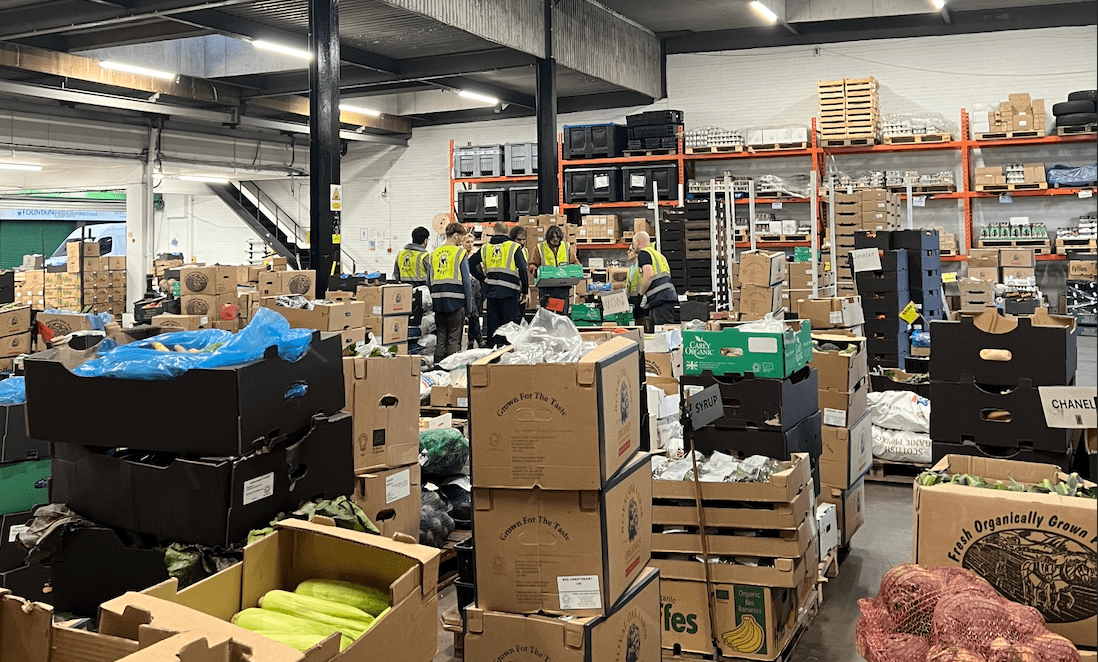
Interested in building new supply chains and routes to market for sustainably-produced food, this article is for you.
While Better Food Traders champions and supports hundreds of sustainable food retailers, we’re also supporting Better Food Traders wholesalers, and working with partners in NGO, policy and academic partners, to try to make progress in the tricky procurement space.
There are a growing number of larger Better Food Traders members who want to serve their local communities with delicious, local and sustainable food either through wholesaling routes, or by supplying public institutions such as schools, universities, hospitals and prisons – aka public procurement.
The challenge in making procurement a reality for sustainable food producers and suppliers is often scale. Organic and agroecological producers tend to work at a much smaller scale (sometimes many multiples smaller) than industrial agriculture, while public procurement contracts are some of the largest contracts available. Matching the scale of supply and demand requires coordination, aggregation, new digital and physical logistics, and skilled middle actors ie wholesalers who can navigate these scale challenges whilst working in a highly competitive, price-driven and regulated market.
Here’s a roundup of how we’re working:
Policy Developments
The government’s recent Organic Action Plan for England includes a target of 10% public spend on certified Organic produce. This is a great demand signal to the food sector, and builds on Labour’s manifesto pledge to source 50% of all food purchased across the public sector from local suppliers, or producers meeting higher environmental standards by the end of this parliamentary term.
In theory, the government has tried to make procurement easier for SMEs with the introduction of the 2026 Local Govt Exclusion of Non-Commercial Considerations Order – giving local authorities in England the option to reserve competitions for lower-value, ‘below-threshold’ contracts to local or UK businesses under certain circumstances. Similarly, the Buying Better Food and Drink Framework (ie contract platform) launched last year was an attempt to open up government food buying to smaller and more locally-rooted players. However, neither seems to have made a huge difference yet, as contracts are renewed on a slow rolling basis; smaller producers work out how to be procurement-ready; and buyers often struggle to see how they can support more local or sustainable purchasing when price pressures are so acute.
At the same time, Prime Minister Andy Burnham’s new government announced a major overhaul of the UK’s public procurement system, with a view to stripping out net zero, environmental, DEI and ESG targets from public contracts. Social value requirements in government contracts will, from January 2027, instead need to focus on job creation, skills training, and economic growth. Contracts under £1 million are exempt from these updated social value requirements, to reduce red tape for small and medium-sized enterprises (SMEs). It’s unclear how this bottoms out for more ethical and sustainable suppliers, as the dropping of net zero and sustainability requirements may penalise Organic, for example, while the focus on local jobs, wages, and regional training may well benefit more local producers and wholesalers.
Wales
In Wales, the Wales Community Food Strategy aims to increase the proportion of public sector food spend on Welsh-origin food by at least 50% by 2030. The Social Partnership and Public Procurement (Wales) Act 2023 introduces statutory social responsibility procurement duties for contracting authorities to actively pursue economic, social, environmental, and cultural well-being. And the Buying Food Fit for the Future Resource was launched as an online procurement tool to help public bodies (such as NHS Wales and local authorities) navigate rules compliantly, shorten supply chains, and source more local food.
Scotland
In Scotland, First Minister John Swinney has announced a dedicated taskforce to increase the use of locally produced food and drink in schools, hospitals and workplaces. Meanwhile the Food For Life Scotland standard, delivered by the Soil Association, aims to raise food standards and sustainability and has recently expanded past school canteens into universities, colleges, care homes, government buildings and courts.
DEFRA research
While we are a way off the 50% local or sustainable food in English procurement pledge, it is encouraging to see DEFRA commissioning two interesting pieces of work to move this forward. First, they are funding five Local Authorities in England (Cambridge, Bristol, Bury, Middlesbrough, Brighton) with £150k each to run short procurement pilots. The five LAs are currently exploring how to source healthier, more sustainable and better value food, and will share their learnings nationwide at the end of the pilots in March 2027.
Meanwhile, DEFRA is also about to launch a schools procurement research project, due to run Jan 2027 to March 2028. 60% of public procurement spend is in education settings – schools, nurseries, universities – and this research this will focus on secondary schools that are using outsourced caterers. We will follow the outcomes of these with interest, to see how Better Food Traders can support LAs and traders to build these ways of working.
Better Food Traders work on Procurement
Better Food Traders is currently working in this space in a number of ways. Last week, our Executive Director attended a meeting of the Procurement for Good consortium held in Cambridge. We sit on the steering group of this academic research project, which is led by Coventry University’s Centre for Agroecology, Water and Resilience. This 4-year project involves active research with four existing food wholesalers/hubs, all of whom are Better Food Traders: Growing Communities/Better Food Shed, Cambridge Organic, Cultivate Food Hub in Powys, Wales and Galloway Food Hub in Scotland. The project is also working with Open Food Network to look at how digital tools can enable consolidation of produce and logistics, so that smaller agroecological producers can feed into the much larger-scale markets of public sector buyers.
Finally, and perhaps most excitingly, Better Food Traders and Sustain have just held the first meeting of the Procurement Catalyst Group. This is a group in which organic food wholesalers will receive training, peer-learning, access to buyers and other procurement experts, and other support over the next 12 months. Better Food Traders will be working with Sustain to scan for policy developments and contract opportunities, as well as feeding back to DEFRA and other government departments about the challenges and support needed in order to make those ambitious procurement targets possible.
Further reading
Finding ways to supply the public sector can often seem complicated, daunting, opaque, and time consuming. That’s why we created a simple guide to help you better understand what’s involved using simple non jargonistic language, and provide some guidance on how to start your journey to supplying the public sector if you feel this is the right path for you. Find the guide here.


