Better Food Traders has a growing body of research and policy work that supports independent, sustainable food traders. As a network, we act as the voice of the sector, calling on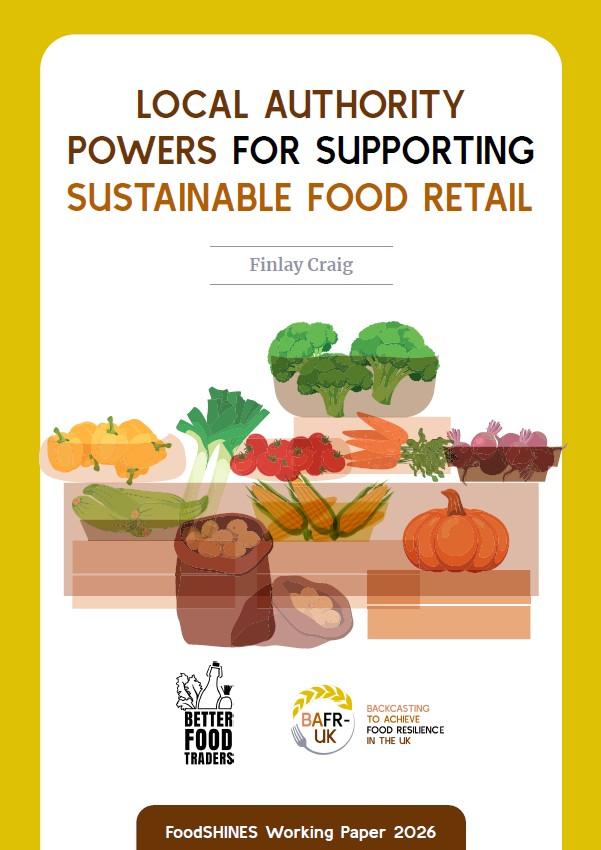 government to make supportive policy changes that will create a better food system, and a level playing field for Better Food Traders.
We are particularly interested in opportunities for change at the Local Authority level, to help build regional food sovereignty, and to improve support for sustainable food enterprises. This year, we have been continuing our work on Business Rates, and also looking at Local Planning powers and the food system.
At the start of this year we developed a policy study in partnership with the FoodSHINES/BAFR-UK Academic Consortium led by Anglia Ruskin University. The resulting report ‘Local Authority Powers for Supporting Sustainable Food Retail’ is available to read here.
Authored by City University Centre for Food Policy PhD student Finlay Craig, the report shows how planning powers can help create the physical conditions for sustainable food retailers to operate, while discretionary business‑rates relief can directly incentivise and support them to deliver social and environmental value. Used together and strengthened through targeted reforms these tools can help local authorities build healthier, more resilient, and sustainable local food systems.
Specifically, it explores how local tax relief for food retailers could be tied to explicit sustainability and community health criteria, using BFT’s membership standards as an accreditation benchmark. It also outlines necessary planning reforms, including adding food system objectives to the National Planning Policy Framework (NPPF), creating a dedicated use class for high-social-value food businesses, and expanding Retail Impact Assessments to account for Scope 3 supply-chain emissions of large retailers.
Over the next 12 months, BFT aims to move this research from today’s report into further policy design – ultimately we’d like to run some regional pilots and set out to central and local government how delivery can be achieved. Overall, this project will help to build food sovereignty through a powerful combination of support for local food production and trading, movement building, and feeding into policy work different regions.
“This report gives local authorities a practical toolkit for backing the food businesses that build healthier, more resilient communities. Planning and business rates are levers councils already hold but what’s been missing is a clear framework for using them with purpose. We’re proud to have worked with Finlay Craig and the FoodSHINES / BAFR-UK Academic Consortium to set that framework out, and we’re excited to now turn this research into real pilots with local authorities who want to lead the way on food sovereignty.” Julia Kirby-Smith, Executive Director, Better Food Traders
We are currently planning a roundtable event for experts across the planning, local government, policy and retail sectors to help us resolve and identify practical and legal barriers to implementing the report’s proposals. Next we hope to work directly with local authorities to refine legal frameworks and administrative mechanisms for rate relief schemes. Then we hope to collaborate with some local authorities to pilot these levers. If you would like to collaborate with us on any part of this process, do get in touch – julia@betterfoodtraders.org.
Our report released today is part of the wider FoodSHINES programme, which has supported a fascinating set of research projects over the course of the last year all related to the UK food system. We encourage you to read the other reports, which were supported by Sustain, WWF and the Met Office:
Here is a summary of the other reports:
- Josephine Heger. 2026. Could a national protein strategy promote pulses for human consumption in the UK’s food system? Lessons from EU countries. BAFR-UK and Sustain.
This report explores how a national protein strategy could strengthen the role of pulses for human consumption in the UK’s food system, including agricultural production, supply chains, and consumption. It draws on observations and learnings from three case studies in the European Union (EU) – Denmark, Flanders and Sweden – to formulate lessons learned and recommendations for UK policy.
- Nikhil Ghosh. 2026. Responding to Climate and Nature Related Food System Crisis: A Review of UK National Policy. BAFR-UK and WWF.
This report contributes to this agenda by offering a typology through which policy for food system transformation can be conceptualised and assessed. It examines the risks to UK agriculture under current policy in the context of a changing climate and future biodiversity risk.
- Muhammad Umar. 2026. Overseas Climate Risks to the UK Food System: Tools, Gaps, and Recommendations for Integrated Risk Assessment. BAFR-UK and Met Office.
This report critically reviews the existing tools, models, datasets, and analytical approaches used to assess overseas climate risks to the UK food system. Its purpose is to identify what current approaches are able to capture well, where they remain insufficient, and what an improved decision-support architecture should look like.
FoodSHINES will publish two more papers and a summary report by December 2026.
BAFR-UK and FoodSHINES are funded by Defra and UKRI.